Service exampleOpen SourceOpen source
OpenBrain
Capture reels, posts, links, and screenshots you save. OpenBrain reads, summarizes, and lets you find them in plain language.
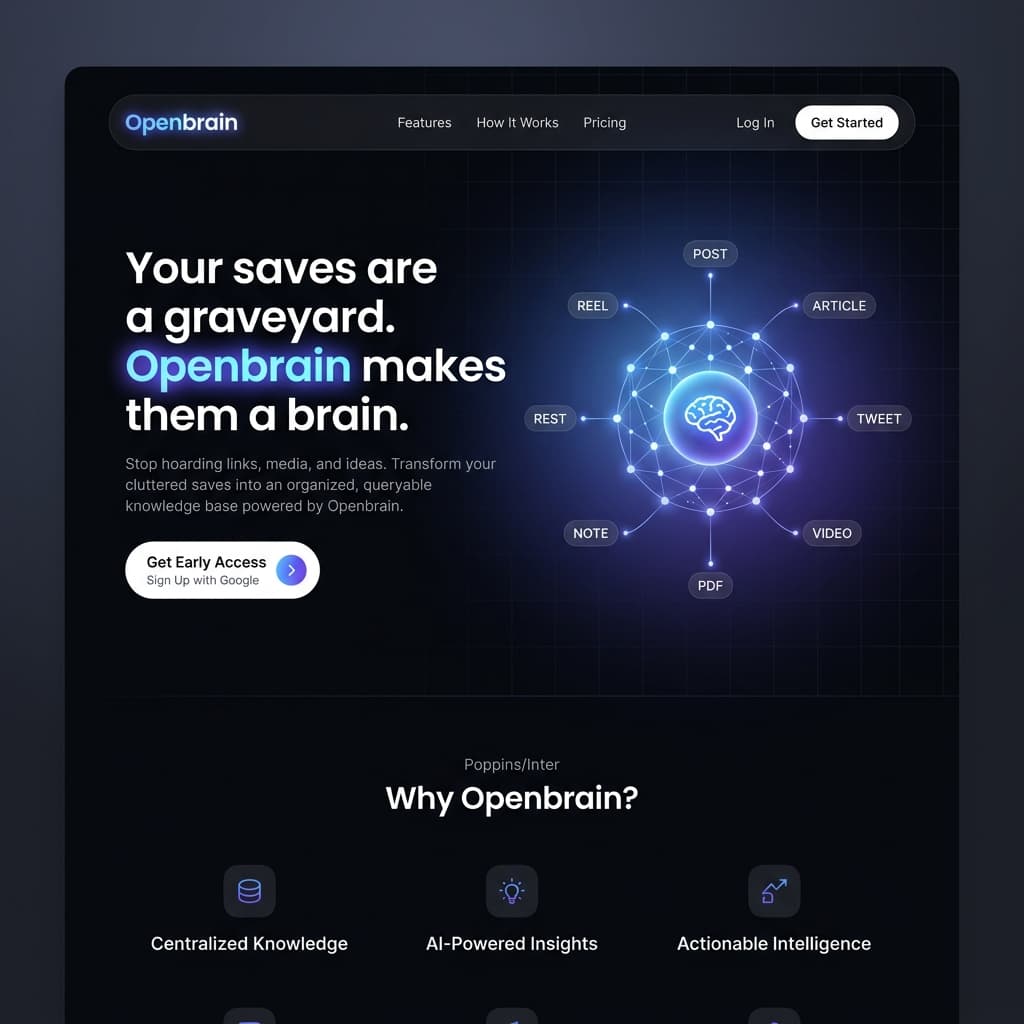
Result
Plain-language search over everything saved
The problem
Everything you save gets saved somewhere you will never look again. Bookmarks, saved reels, screenshots: all of it is write-only.
What I built
Built an ingest pipeline that reads each item on the way in, pulling text out of screenshots with OCR and transcripts out of video, then embedding the result so it can be searched by meaning.
The outcome
You can ask for the thing you half-remember saving and actually get it back. Self-hostable, so the archive stays yours.
How it works
- 01
An item is saved: a link, a screenshot, a reel, a post.
- 02
It is read on the way in, not on the way out: OCR for images, transcription for video, extraction for pages.
- 03
The extracted text is summarised and embedded, so the item is searchable by what it was about rather than by its filename.
- 04
Retrieval answers a half-remembered description instead of requiring the exact words it contained.
The AI layer
OCR and transcription at ingest, summarisation for a readable record, and embeddings for meaning-based search. Doing the expensive reading once at write time is what makes search cheap at read time.
The engineering layer
An ingest queue that survives the item it cannot parse, a vector store, and a deployment shape simple enough that self-hosting is realistic rather than theoretical.
Key technical decisions
Read at ingest, not at query time.
Processing on the way in costs more once and makes every later search fast. Processing on the way out means every query pays for OCR again.
Self-hostable, because of what people save.
A personal archive is the last thing anyone should be asked to hand to a third party. Self-hosting is the feature, not a deployment option.